Author: robertsunyq

Celebration of Learning

  1. Examine the application of social media to support learning

In week 1 wow and wonder post, I used the article ā€œWhat is a Personal learning Networkā€ to support my learning in the application of social media to education. From the article, I’ve learned that PLN is a group of colleagues and professionals that people connect with to enhance personal learning and professional development. The keyword is ā€œconnectionā€ because social media platforms have the advantage to group different people together, whether synchronously or asynchronously. Furthermore, the author in the article looked at the trend in the future, where rapid economic and social changes could happen under the climate change and the Covid-19, emphasizing the importance of building PLN by applying social media platforms to support learning. In Riya’s Week #2 Wow and Wonder post, she has a similar view of how world in rapidly changing due the Covid-19. I also agree on her point that people should adapt to the changed in the environment. From my own experience, I already took two years of online course at Uvic, and some of the courses ask students to find resources on platforms like Twitter. In this course, I got opportunity to work with my group members on Instagram, which I think is so meaningful. I did research on the education aspect of Instagram and I enjoy what I found and learned. Instagram is actually a very powerful tool for students to learn more effectively because educators and use images, videos, and graphics to support text in a clear way. People can learn materials on Instagram that would help them succeed in university, as well as in life. Therefore, after taking this course, my view has broadened by the class materials and the group project. I now firmly believe that social media can be a great tool for educators in regular/digital classrooms.

  • Explain personalized learning and its relation to learning theory

I had some previous knowledge on learning theories because of my psychology background. Therefore, when learning from the article ā€œConnectivism, A Learning Theory for the Digital Ageā€, I recognized that this learning theory will be based on connecting with others by using digital technologies. I learned from the article that learning is not just about gaining most of the knowledge, and what’s more important is to learn from community-based networks. From my personal experience, I think connectivism is very advantaged by increasing the motivation from the learners. In my Wow and Wonder #2 post, I’ve shown my understanding on connectivism and its relationship with PLN. PLN is a way of showing learning with connectivism because it is strongly influenced by technology and connectivism focuses on a learner’s ability to frequently source and update accurate information. In Riya’s Week #3 – Wow and Wonder post, she uses co-op as an example to explain informal learning such as learning from a community, personalized learning, are so important. I strongly agree with Riya that co-op provides opportunities for students to apply their knowledge learned in a formal learning setting in an informal learning setting. Riya’s post once again demonstrates that the personalized learning (PLN, learning from a community, etc) is closed related to connectivism. Connectivism makes students learn best if they are taught to navigate and create social networks via technology and use these networks to learn.

  • Recognize that the Internet is not a neutral or equal space for everyone

I’ve noticed a lot of inequality received by the minorities in our society throughout my psychology degree. I also recognized that internet is not an equal or neutral space for everyone. In my Wow and Wonder post #5, the article ā€œIt’s Not Misinformation. It’s Amplified Propagandaā€ by Renee DiResta shows that people use fake accounts to draw attention in the media. The result can be devastating because people react to the information differently. Those ā€œunimportant informationā€ can influence our perception and decision-making. Therefore, it’s extremely important to filter out misinformation. In the major project, I applied the concept media literacy to Instagram use in the reflection. I think it’s extremely important to know that media literacy is not just about ā€œprotectingā€ us from unwanted messages. Instead, it is more abut helping us become critical and literate in all media forms so that we control the interpretation of what we see or hear rather than letting the interpretation control us. We cannot force the internet to become equal and neutral for everyone, however, we can control ourselves and develop abilities to be competent in disinformation prevention.

  • Apply social media to develop a personal learning network in support of your personal and/or professional development

I primarily use Instagram and Twitter for my own PLN. Instagram is a unique social media network and people only share images and videos. I think Instagram is a powerful tool for learning sometimes when it comes to understand a concept. The creator of the posts uses good images and videos to illustrate the key points in one concept, which makes it easy for comprehension. After taking this course, I noticed there’s more educators can do with Instagram, such as creating e-portfolios. Furthermore, as I mentioned in the major project, Instagram can help building interpersonal skills. In my other courses at Uvic, I connect with my classmates mostly on Instagram. Therefore, Instagram is a great tool for building connection with your learning partners. I also got an opportunity to use WordPress in this course which is super cool. I think it’s easy to use and I can share my posts as well as comment on someone else’s posts. In sum, I learned that education can be done through social media platforms and technologies, and they are motivating and fun to use.

  • Identify privacy issues and practice online behaviours that are legal, sage, consensual, and ethical

Although technology is easily accessible and more people are getting familiar with it, however, it’s important to note the privacy issues. The short film made by Queen’s University ā€œ#tresdancingā€, speculates on the effects of escalating surveillance and control through educational technology. There’s no privacy for students if surveillance technology is used. After taking the quiz ā€œPrivacy, Ethics & Security in Digital Spaces Developing Awareness of Privacyā€, I think it is a good way to increase my awareness of social media surveillance. Governments might purchase sophisticated technology to monitor their citizens’ behavior on social media. There is no privacy for social media users unless you never use it. From the major project, I noticed the developers of Instagram are holding a tremendous amount of data from the users. It’s extremely important to know how the data are used, whether it’s used only to provide advertisement for users’ interests or other negative purposes.

  • Recognize data ownership and licensing (Creative Commons, Copyright, Fair Dealing, and Public Domain) as a core practice when creating, sharing, or using resources online

Me and my group in the major project explored Instagram. I’ve learned how social media like Instagram turns consumers into producers and how content is licensed through these services. It’s been clearly stated on the terms that Instagram does not claim ownership of the photo that you post. The terms include a clause about granting a transferable license to use and display your content. Instagram makes it explicit that they may use or remix your content for the purposes of advertising and promotion and can do so without consent or notice you. Instagram expect users to follow the law when posting their photos and videos. Some of the laws are ā€œrespect other members of the Instagram communityā€, ā€œFoster meaning and genuine interactionsā€, and ā€œBe thoughtful when posting newsworthy eventsā€.

  • Practice digital, networked, and open literacies in support of learning about social media and personalized learning

I’ve practiced using digital, networked, and open literacies to support my learning about social media and personalized learning. For schoolwork, I use my laptop mainly to watch lectures and take notes. I have a network that allows me to connect with my professors, which consist of Gmail, Brightspace, Zoom, Microsoft Team, and Github. I also use platforms such as Instagram, Facebook messenger to connect with my peers. It surprises me sometimes those social media platforms have contributed a lot for my personal learning. After taking this course, I’ve learned the importance of social networking, that they are not just communication tools, they are facilitators in our learning and professional development. In my showcase #1 post, I demonstrated open literacy by using Twitter as my PLN. Social media platforms like Twitter encourage for open discussion, which gives people plenty of room to focus on their interests in learning.
Wow and Wonder #7

For this week’s post, I want to discuss about the reading ā€œEmerging Technologies in Distance Educationā€ by George Veletsianos. Most definition of distance learning include the use of technology. Veletsianos refer to the degree of interactivity and the distance between learners. Technological advances have created a paradigm shift in education. Distance education is becoming a common practice as evidenced by the number of universities that offer distance education programs. My Wow for this week is the fast pace of the shift in education. For me personally, I still favour traditional classroom over online classroom. However, after finishing the reading of this week, I think the technology has become more mature. Distance education is a trend in the future and we should think forward. My wonder for this week is how educators can get the most from technologies? The concern should be how teachers are educated to teach with technologies in different settings. Teachers need more trains too.

Wow and Wonder #6

For this week’s post, I want to discuss about the film made by Queen’s University students about screening surveillance ā€œ#tresdancingā€. This short film showed how surveillance can play a role in supporting students’ learning. My wow for this week is when I saw how technology can monitor people today. From eye movement to voice detection. This also leads to the wonder. I wonder if this is really the future for learning, having every detail of the students. Will this make them do better? Could there be a potential to form mental disorders? What if technologies go wrong?

Wow and Wonder #5

For this week I want to talk about the article ā€œIt’s Not Misinformation. It’s Amplified Propagandaā€ by Renee DiResta. The article described the discrepancies between social media regarding one’s account, or their posts. My wow for this week is that I think people/companies today recognize the importance of getting attention on social media platforms. So they are willing to anything that can help their content get popular. On Instagram there are so many bots and puppet accounts and sometimes I got followed by them. This is a strategy because usually people will open the profile page of the bots account once they got followed. From the profile page we might get exposed to false information. My wonder is that how to make social media platforms a better, clean place overall for everyone.

Wow And Wonder #4

For this Wow and Wonder post, I will be talking about Shelley Moore’s videos.

Wow

From the video, I learned that inclusive teaching strategies are intended to ensure that all students feel supported such that they freely learn and explore new ideas, feel safe to express their views in a civil manner, and respected as individuals and members of groups. Like Shelley Moore suggested, teaching is like bowling. If you aim at the middle, most students are being cared, but not everyone (the ones on the side also need the support). I think this is something education in general that is the most difficult part – to get every student included.

Wonder

I’m wondering if there’s a strategy that will help forming inclusion in teaching. Also, since there’s a trend of transforming education online, are online education better than traditional education in forming a more inclusive, caring environment for learners?

Showcase Post #1

In this post, I will be expanding my original ā€œWow and Wonder #1ā€ post and investigate further about Personal Learning Networks (PLNs).

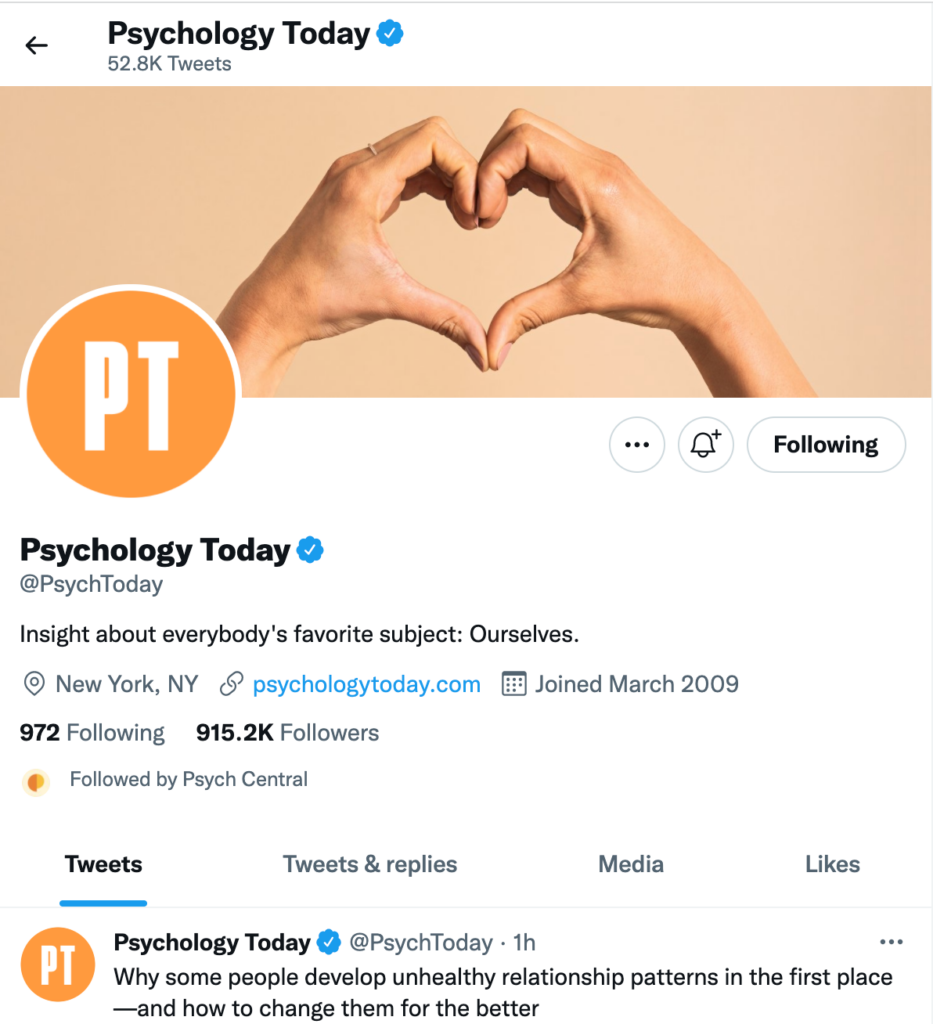
The official account for ‘Psychology Today’ on Twitter that I followed

Wow

In the article ā€œWhat are Personal Learning Networks?ā€, the author clearly stated the definition of PLN and its importance in current trend. I learned that PLN is a group of people, such as colleagues and professionals, that you connect with to enhance your learning and professional development. The most unique aspect of PLN is that people can learn anywhere at any time. There’s an article I found called ā€œ20 Tips for Creating a Professional Learning Networkā€, by Miriam Clifford. There are some points in the article that really stuck out to me. One of the points under the ’10 Tips For Using PLNs’ section that interested me was when she wrote about ā€œbecoming a beacon of light.ā€ This means that if there’s some information that you know or perhaps you have anything that’s related to a certain topic, that you should share it with everyone to generate more interest. Therefore, I think Twitter would be a better platform for me to set up a PLN. Recently, I set my own PLN by creating a new account on Twitter to be used specifically for content to Psychology, which related to my field of study. I followed an official account called Psychology Today, and the resource there is so rich and they always have a new post in every hour. Furthermore, Twitter allows and encourages for open discussion that perfect fits the criteria of a PLN. I’m amazed by the fact that we can set our own PLN with such an ease, because they are around us closely.

In the article, ā€œWhat is a Personal Learning Networkā€, the author takes a good perspective of looking at the relationship between PLN and Covid-19. In Riya’s Week #2 – Wow and Wonder post, she mentioned about Covid-19 as a main factor of this shift toward online learning. I strongly agree with this perspective and I also believe Covid-19 is life changing for everyone, also a world-changing factor that will cause revolution in many areas. For example, as Riya and the article ā€œWhat is a Personal Learning Networkā€ suggested, education is undergoing a rapid and urgent transformation that require people to adjust quickly.

Wonder

Riya in her post was wondering if we can go back to traditional learning. I also raised a concern about education in the future because learning should not be totally ā€œonlineā€. I think face-to-face discussion is still the most effective way for learning and as online learning become more popular, the essentials about traditional learning may soon fade away. In Jiaxing’s Week #2 Wow and Wonder post, she addresses another concern we should deliberate about — not everything on internet is helpful for learning. For young population, they are more vulnerable to get impacted negatively on internet. Despite the resourceful content for learning on social medias such as Twitter, violence and misguided information are social medias as well. It’s especially important to filter out those content for young people so they don’t get exposed to undesirable content on internet. I’m wondering if Twitter can come up with another Ā educational version that’s for education purpose only.

References

What is a Personal Learning Network (PLN)? (n.d.). Retrieved fromĀ https://www.futurelearn.com/info/courses/learning-network-age/0/steps/24644

Gutierrez, K. (n.d.). What are Personal Learning Networks? Retrieved fromĀ https://www.shiftelearning.com/blog/personal-learning-networks

20 Tips for Creating a Professional Learning Network. Retrieved from https://www.opencolleges.edu.au/informed/features/20-tips-for-creating-a-professional-learning-network/

Wow And Wonder #3

For this Wow and Wonder post, I will be talking about the article, ā€œVisitors and Residents: A new typology for online engagementā€.

Wow

From the article, I learned that Visitors and Residents is a simple way of describing the range of ways individuals can engage with the Web. It’s a continuum of ā€˜modes of engagement’ not two distinct categories. It has proved to be a useful way to come to an understanding of individuals’ motivations when they use the web in differing contexts. For me personally, reddit and twitter are belonged to the Visitor side; Instagram and Facebook belong to the Residents side.

Wonder

I’m wondering if there’s a correlation of Visitor/Residents map and level of education. Are people with higher academic achievement have less social media accounts (visitor more than residents)?

Wow And Wonder #2

For this Wow and Wonder post, I will be talking about the article, ā€œConnectivism: A Learning Theory for the Digital Ageā€

Wow

For a PLN to be successful – to thrive and for its collective knowledge to evolve – there needs to be a diverse set of people connected to the network. I think this summarize the relationship between connectivism and PLN perfectly. Connectivism and PLN work closely to build a good learning environment for students with flexibility. In the current ā€œdigital ageā€, it is becoming increasingly important to develop the ability to know where to find information, rather than know the information itself. I just got amazed by the rapid change of society and the trend in the future will be more likely in digital.

Wonder

I’m thinking if different people have different preferences for their learning. For example, one might be more like an individual learner and is more independent than others in learning. Would connectivism still apply to individualistic people?

Wow And Wonder #1

For this Wow and Wonder post, I will be talking about the article, ā€œWhat are Personal Learning Networks?ā€

Wow

In the article, it has been suggested that learning networks are based on the theory of connectivism, or learning from diverse social webs. Connectivism implies that learning relies on communicating ideas with others. PLN today facilitate learning through meaning interactions. This is definitely something new to me because I was more of a traditional education learner. Due to the pandemic, online learning the PLN is probably the trend for future education and people should be prepared to adjust themselves.

Wonder

Although PLN can improve classroom teaching and help develop new projects, however, I’m wondering if this can hurt traditional education and learning. What if some learners struggle to adjust to this new learning platform? Can there be a more flexible way for learning?

© 2026 EDCI 338 RS

Theme by Anders NorenUp ↑